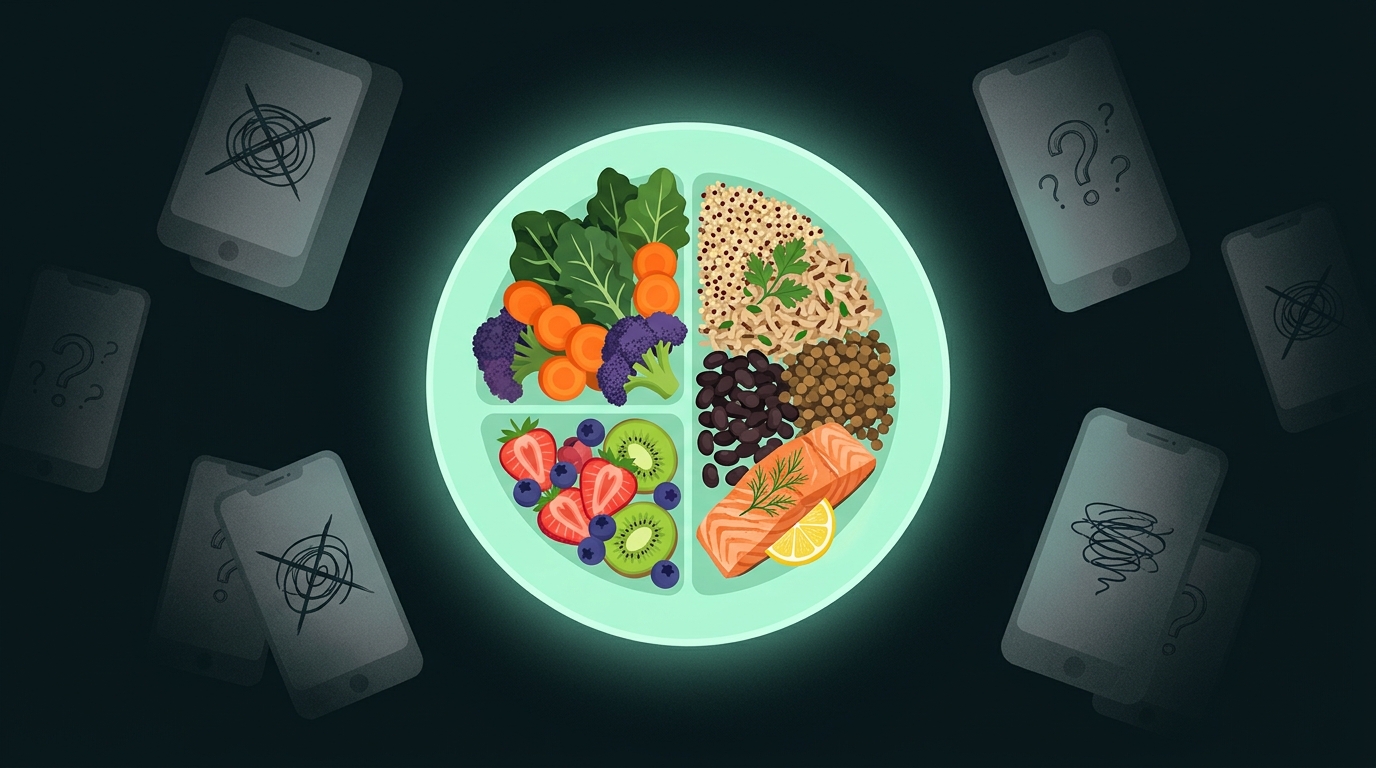
Within days of a cancer diagnosis, almost everyone I meet has been handed a diet. A cousin forwards a video saying sugar "feeds" tumours. A neighbour swears by an alkaline water machine. A social media account with thousands of followers insists that fasting will "starve" the cancer, while another says you must never touch red meat again. Some of this advice contradicts itself. Much of it is delivered with total confidence. And all of it lands on people who are already frightened, exhausted, and desperate to do something to help themselves.
That instinct — to take back some control through what you eat — is completely understandable, and it is a good instinct. Food genuinely matters during cancer treatment. But it matters in a different way from what most viral posts suggest. In this article I want to walk through the five food myths I hear most often, explain what the evidence actually shows, and talk honestly about the one dietary danger that rarely gets mentioned online: not eating enough.
Myth 1: "Sugar feeds cancer"
Cancer cells live on sugar, so cutting every gram of sugar out of your diet will starve the tumour and slow it down.
Cancer cells do use a lot of energy, including glucose — but so does every cell in your body, from your brain to your muscles. Cancer Research UK points out that cancer cells also need other nutrients, such as amino acids and fats, and that there is currently no way to specifically starve cancer cells of glucose without harming healthy cells too. There is no evidence that a sugar-free diet improves survival after a diagnosis, and Cancer Research UK warns that patients restricting their own diet during treatment could be dangerous. Where sugar does matter is indirectly: diets high in sugar can lead to weight gain, and being overweight or obese increases the risk of 13 different types of cancer. That is a reason for sensible moderation over the long term — not for fear of every spoonful during treatment.
I go into the science in much more detail in Does Sugar Feed Cancer? What the Science Really Says.
Myth 2: "Red meat causes all cancers"
Any red meat is poison for someone with cancer, and eating it causes cancer everywhere in the body.
This myth takes a real finding and stretches it far beyond the evidence. The World Health Organization's cancer agency (IARC) classifies processed meat as carcinogenic to humans (Group 1) — the evidence shows it causes colorectal (bowel) cancer — and classifies red meat as probably carcinogenic (Group 2A), with the strongest evidence again for colorectal cancer and some evidence for pancreatic and prostate cancer. The risk increases with the amount eaten. That is very different from "causes all cancers." The WHO also notes that meat can be part of a healthy diet and provides nutrients that are important for good health. The World Cancer Research Fund's practical advice is to eat no more than about three portions of red meat a week (about 350–500 g cooked weight) and little, if any, processed meat. During treatment, when your body may need extra protein to heal and maintain muscle, a modest amount of lean, unprocessed meat can be a useful part of the plate.
Myth 3: "Fasting starves tumours"
If you stop eating, the cancer will starve faster than you do — so fasting, or eating very little, is a natural way to fight it.
Your body does not ration food in favour of healthy cells. When you don't eat, it breaks down its own fat and, importantly, muscle to keep going — and loss of muscle is one of the strongest warning signs in cancer care. Short-term, carefully timed fasting around chemotherapy is being studied: in one randomised phase 2 trial in women with early breast cancer, a supervised "fasting-mimicking" diet for a few days around each chemotherapy cycle showed encouraging signals, and researchers are calling for more studies. But these are controlled research settings with selected patients. Europe's clinical nutrition society (ESPEN) concludes that, because of the risks of malnutrition and because patients may be tempted to prolong fasting, fasting during chemotherapy cannot be recommended without firm evidence of benefit.
For more on fasting, ketogenic diets and other extreme plans, see Fasting, Keto and Extreme Diets During Cancer Treatment.
Myth 4: "Organic food prevents cancer from coming back"
Switching to an all-organic diet will stop the cancer from returning; conventional fruit and vegetables are dangerous because of pesticides.
Organic produce is less likely to carry pesticide residues, and some people prefer it for that reason — which is a perfectly reasonable personal choice. But there is no evidence that eating organic food prevents cancer recurrence. Large studies in people without cancer give mixed answers: a French cohort of nearly 69,000 adults found that frequent organic eaters had a modestly lower rate of cancer (an absolute difference of 0.6%), while a UK study of more than 620,000 women found no reduction in overall cancer. These studies are observational, so organic eaters may differ in many other healthy ways. The far bigger health gain comes from eating enough vegetables and fruit at all — washed well — whether or not they carry an organic label.
Myth 5: "An alkaline diet changes the pH of a tumour"
Cancer thrives in an "acidic" body, so alkaline foods or alkaline water will make your body less acidic and stop the tumour growing.
Your body tightly controls the pH of your blood, and your kidneys simply excrete any extra acid or alkali into the urine. In one well-conducted trial reviewed by researchers, changing the diet raised urine pH by about one unit but changed blood pH by only 0.014 units — far too little to matter. That is why a urine test strip tells you about your last meal, not about your body or your tumour. The acidic area around a tumour is created by the tumour's own metabolism, not by what you ate for lunch. A systematic review found almost no research supporting alkaline diets or alkaline water for preventing or treating cancer, and concluded that promoting them to the public for this purpose is not justified.
Organic, alkaline and "superfood" claims are covered in depth in Organic, Alkaline and “Superfoods”: How to Spot Cancer Diet Myths.
The hidden danger: when "eating clean" becomes not eating enough
Here is the part of the conversation that social media almost never covers. The most common and most serious nutrition problem in cancer care isn't eating the "wrong" food — it is not eating enough food. Treatment itself can reduce appetite, change taste, cause nausea, mouth sores, or bowel problems. When a strict, self-imposed diet is layered on top of that — no sugar, no meat, no dairy, no grains, fasting days — people can lose weight and muscle remarkably quickly.
That matters because, according to the ESPEN guidelines, malnutrition and loss of muscle mass are frequent in people with cancer and have a negative effect on clinical outcome. Loss of skeletal muscle predicts physical impairment, complications after surgery, more severe chemotherapy side effects, and higher mortality. In a large analysis of more than 11,000 people with advanced cancer described in those guidelines, both a low body-mass index and the amount of weight lost independently predicted survival. The US National Cancer Institute adds that staying well nourished helps people receive their treatment without unplanned breaks, and that being malnourished before surgery can make healing harder.
For these reasons, ESPEN makes a strong recommendation against diets that restrict energy intake in people who have, or are at risk of, malnutrition. It also discourages fad diets, which tend to cut out whole food groups and raise the risk of not getting enough energy, protein, and micronutrients. In plain terms: during treatment, a diet that makes you smaller and weaker is not a diet that is helping you fight.
It is also worth knowing about cachexia, a wasting syndrome that can cause weakness and loss of weight, fat, and muscle — and, as the National Cancer Institute notes, it can happen even when someone is eating well. This is one more reason why weight loss during treatment should always be reported to your team rather than celebrated or ignored.
A more hopeful way forward
If there is one message I want you to take from this article, it is that you don't have to figure this out alone — and you don't have to be perfect. The goal of nutrition during cancer treatment is simple to say, even if it takes some expert help to achieve: keep your strength, protect your muscles, and stay well enough to complete the treatment that is most likely to help you.
The best person to help with that is a clinical (registered) dietitian working alongside your oncology team. A dietitian can assess your weight, appetite, side effects, and blood tests, and build an eating plan around you — your cancer, your treatment, your culture, and your food preferences. Sometimes that plan will look very different from what we usually think of as "healthy eating": the National Cancer Institute notes that people with cancer often need to follow diets that are different from the usual advice, such as extra calories and protein when appetite is poor. That is not a failure of willpower; it is good medicine.
Social media nutrition influencers can be warm, persuasive, and confident. But they don't know your diagnosis, they won't see your blood results, and they won't be there if your weight starts to drop. Your oncologist and dietitian will. Bring them the questions, the screenshots, and the forwarded messages — a good team would much rather talk them through with you than have you quietly follow advice that could set you back. Read more about how side effects such as appetite loss are managed in Cancer Treatment Side Effects: What to Expect, and about other common misunderstandings in Cancer Misconceptions.
Should I cut out sugar completely after a cancer diagnosis?
No. There is no evidence that a sugar-free diet improves survival, and there is currently no way to starve cancer cells of glucose without harming healthy cells. Restricting your own diet during treatment can be dangerous. Over the long term, limiting added sugar helps you keep a healthy weight, which matters because obesity increases the risk of several cancers.
Is it safe to eat red meat during cancer treatment?
For most people, yes, in moderation. Processed meat is classified as carcinogenic and red meat as probably carcinogenic, mainly for bowel cancer, and the risk rises with the amount eaten. The World Cancer Research Fund suggests no more than about three portions of red meat a week and little, if any, processed meat. Lean, unprocessed meat can help meet the extra protein needs of treatment.
Can fasting make chemotherapy work better?
Short-term fasting around chemotherapy is being studied in clinical trials and has shown some early, encouraging signals in supervised research settings. It is not proven, and European nutrition guidelines advise against fasting during chemotherapy because of the risk of malnutrition. Never fast during treatment without discussing it with your oncologist.
Do I need to buy organic food now that I have cancer?
No. Organic food may contain fewer pesticide residues, but there is no evidence that it prevents cancer from coming back. Eating enough vegetables, fruit, and protein — well washed, organic or not — matters far more.
Who should I ask about my diet during treatment?
Ask your oncology team to refer you to a clinical (registered) dietitian. They can tailor advice to your cancer, your treatment, your side effects, and your food preferences, and help you avoid unintended weight and muscle loss.
Sources
- Cancer Research UK. Sugar and cancer – what you need to know (updated 16 August 2023). https://news.cancerresearchuk.org/2023/08/16/sugar-and-cancer-what-you-need-to-know/
- World Health Organization. Cancer: Carcinogenicity of the consumption of red meat and processed meat (Questions & answers). https://www.who.int/news-room/questions-and-answers/item/cancer-carcinogenicity-of-the-consumption-of-red-meat-and-processed-meat
- World Cancer Research Fund. Limit consumption of red and processed meat — recommendation evidence. https://www.wcrf.org/research-policy/evidence-for-our-recommendations/limit-red-processed-meat/
- de Groot S, et al. Fasting mimicking diet as an adjunct to neoadjuvant chemotherapy for breast cancer in the multicentre randomized phase 2 DIRECT trial. Nat Commun. 2020;11(1):3083. doi:10.1038/s41467-020-16138-3
- Arends J, et al. ESPEN guidelines on nutrition in cancer patients. Clin Nutr. 2017;36(1):11-48. doi:10.1016/j.clnu.2016.07.015
- Baudry J, et al. Association of Frequency of Organic Food Consumption With Cancer Risk: Findings From the NutriNet-Santé Prospective Cohort Study. JAMA Intern Med. 2018;178(12):1597-1606. doi:10.1001/jamainternmed.2018.4357
- Bradbury KE, et al. Organic food consumption and the incidence of cancer in a large prospective study of women in the United Kingdom. Br J Cancer. 2014;110(9):2321-2326. doi:10.1038/bjc.2014.148
- Fenton TR, Huang T. Systematic review of the association between dietary acid load, alkaline water and cancer. BMJ Open. 2016;6(6):e010438. doi:10.1136/bmjopen-2015-010438
- National Cancer Institute. Nutrition During Cancer Treatment (PDQ®, patient version). https://www.cancer.gov/about-cancer/treatment/side-effects/appetite-loss/nutrition-pdq
- Roeland EJ, et al. Management of Cancer Cachexia: ASCO Guideline. J Clin Oncol. 2020;38(21):2438-2453. doi:10.1200/JCO.20.00611
Last reviewed: November 13, 2026
Medical guidance changes; check the latest official recommendations.
This website provides general educational information only. It is not medical advice, diagnosis, or treatment, and it does not create a doctor-patient relationship. Consult a qualified healthcare professional about your own condition. In an emergency, call 997.