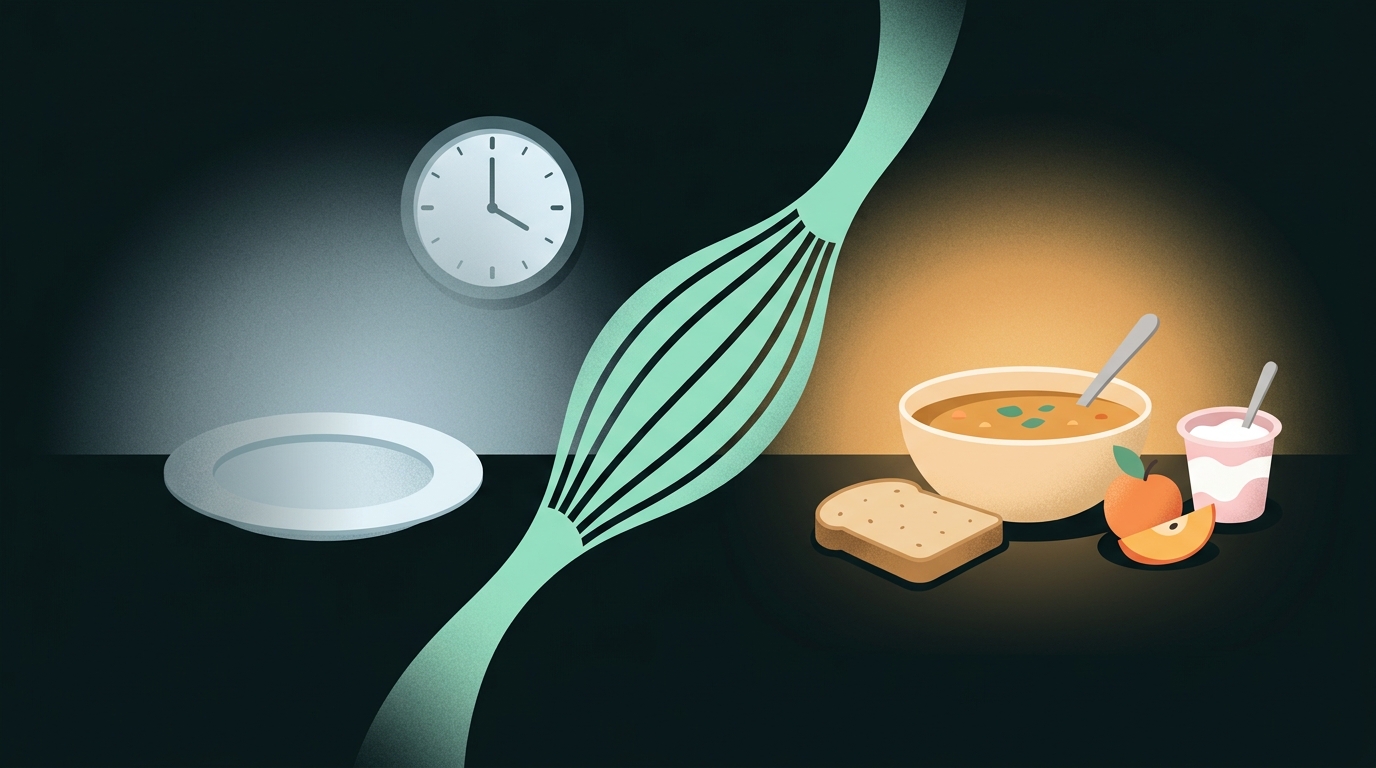
"Starve the cancer." It is one of the most appealing ideas on the internet, because it promises patients something powerful: a way to fight back using nothing but willpower. Videos describe water fasts, "cancer-killing" ketogenic plans, juice cleanses, and diets that cut out sugar, grains, dairy, and meat all at once. Some of the people sharing them are sincere. Very few of them will be there if the person following their advice starts losing strength halfway through chemotherapy.
In this article I want to look honestly at fasting and ketogenic diets — what has actually been studied, what remains unproven — and explain the risk that matters most during treatment: losing weight and muscle you need.
Why weight and muscle matter so much during treatment
Cancer and its treatment place a heavy demand on the body. At the same time, side effects — poor appetite, nausea, taste changes, mouth sores, diarrhoea or constipation — often make eating harder. According to the European Society for Clinical Nutrition and Metabolism (ESPEN), malnutrition and loss of muscle mass are frequent in people with cancer and have a negative effect on clinical outcome.
The guidelines explain that it is specifically the loss of skeletal muscle that predicts physical impairment, complications after surgery, chemotherapy toxicity, and mortality. In an international analysis of more than 11,000 patients with advanced cancer cited in the guidelines, both a low body-mass index and the amount of weight lost independently predicted survival. The US National Cancer Institute adds that good nutrition helps people receive treatment without unplanned breaks, and that malnutrition before surgery can slow healing.
For orientation, ESPEN estimates that most people with cancer need roughly 25–30 kcal per kilogram of body weight per day, with protein intake above 1 g/kg per day and, if possible, up to 1.5 g/kg. Your own needs may differ — this is where a dietitian's assessment is so valuable — but these numbers show why "eating less" is rarely the right direction during treatment.
Fasting: what the research actually shows
The idea of fasting around chemotherapy didn't come from nowhere. In animal experiments, short-term fasting protected healthy cells from some toxic effects of chemotherapy while appearing to make treatment more effective. That has led to careful human research.
The best-known example is the DIRECT trial, a randomised phase 2 study of 131 women with HER2-negative stage II or III breast cancer. Half followed a supervised "fasting-mimicking diet" — a very low-calorie plan — for three days before and during each cycle of chemotherapy given before surgery. Side effects were similar between groups, and tumour responses on imaging were more frequent in the fasting-mimicking group. The researchers described the findings as encouraging further exploration. Importantly, the trial excluded people with diabetes and those who were underweight, and participants were closely monitored.
So the honest summary is: short, supervised fasting around chemotherapy is an active area of research, not an established treatment. ESPEN's guideline puts it clearly: because of the risks of malnutrition, and because patients might be tempted to prolong fasting episodes, without firm evidence of a benefit, fasting during chemotherapy cannot be recommended.
If you are interested in fasting research, the right place for it is a clinical trial run by your oncology team — not a self-directed water fast based on a video.
A note on religious fasting
Many of my patients ask about fasting for religious reasons, such as during Ramadan. This is a deeply personal matter, and it deserves a careful, respectful conversation. Please raise it with your oncology team well before the fasting period begins: they can look at your treatment schedule, medicines, blood tests, and weight, and advise whether fasting is safe for you and, if so, how to do it with the least risk.
Ketogenic diets: promising in mice, unproven in people
A ketogenic ("keto") diet is very high in fat and extremely low in carbohydrates. The theory is that, by depriving tumours of glucose, it will slow their growth. In animal studies, a systematic review and meta-analysis found that ketogenic diets prolonged survival and reduced tumour size in some tumour types in animals.
But people are not mice. ESPEN notes that there are no clinical trials demonstrating a benefit of a ketogenic diet in cancer patients; two small pilot studies, in glioblastoma (a brain tumour) and in mixed advanced solid tumours, did not see tumours respond. The guidelines also highlight a practical problem: because ketogenic diets are often unpalatable, they may lead to insufficient energy intake and weight loss — exactly what we are trying to avoid during treatment.
If you are considering a ketogenic diet, discuss it with your oncologist and a dietitian first. In some situations it may be studied within a trial; it should not be started on your own during active treatment.
Juice cleanses, "detoxes" and elimination diets
Many popular "anti-cancer" plans cut out entire food groups at once — dairy, meat, wheat, sugar, or anything cooked. ESPEN discourages dietary advice or diets that increase the risk of inducing or worsening malnutrition, and notes that fad diets are generally highly restrictive, raising the risk of not getting enough energy, fat, protein, and micronutrients. ESPEN makes a strong recommendation against using diets that restrict energy intake in people who have, or are at risk of, malnutrition.
There is also a hidden cost: the stress and guilt of trying to follow rigid rules while you are unwell. Food can and should still be a source of comfort and connection with family during treatment.
Cachexia: when weight loss isn't about willpower
Some people lose weight even when they are trying hard to eat. Cancer cachexia is a wasting syndrome that causes weakness and loss of weight, fat, and muscle, and the National Cancer Institute notes it can occur even when someone is eating well. It is driven by the cancer's effects on the body's metabolism and inflammation, not by a lack of effort.
The American Society of Clinical Oncology (ASCO) guideline on cachexia recommends that dietary counselling may be offered to help patients and caregivers manage it, and that tube feeding or intravenous nutrition should not be used routinely. Your team will tailor the approach to your situation. The key message for families: weight loss in cancer is a medical sign to report, not a personal failure — and certainly not something to encourage with fasting.
What actually helps
- Get screened. ESPEN recommends that all people with cancer are screened regularly for malnutrition risk. Ask your team to check your weight and nutrition at each visit.
- See a clinical dietitian early — ideally before weight loss starts.
- Eat little and often if large meals feel overwhelming, and prioritise protein-rich foods.
- Treat the side effects that stop you eating — nausea, mouth sores, constipation — rather than accepting them.
- Talk before you try. Bring any fasting or special-diet plan to your oncologist first, including religious fasting.
This article is part of a series. Read the overview, Eating Through Cancer: Separating Food Facts from Fiction, the sugar deep dive, Does Sugar Feed Cancer?, and how side effects are managed in Cancer Treatment Side Effects.
Can fasting starve a tumour?
No. When you don't eat, your body breaks down its own fat and muscle; it does not selectively starve the cancer. Short, supervised fasting around chemotherapy is being studied in trials, but European nutrition guidelines state that fasting during chemotherapy cannot be recommended without firm evidence of benefit, because of the risk of malnutrition.
Does a ketogenic diet cure or slow cancer?
There are no clinical trials showing a benefit of a ketogenic diet in people with cancer. It has shown effects in some animal studies, but small pilot studies in patients did not see tumours respond, and the diet can cause weight loss because it is hard to eat enough.
Is it safe to fast in Ramadan during cancer treatment?
It depends on your treatment, medicines, and health. Discuss it with your oncology team well before Ramadan, so they can advise whether fasting is safe for you and how to reduce any risks.
Why does my doctor worry about weight loss during treatment?
Loss of weight and especially muscle is linked to more treatment side effects, surgical complications, physical weakness, and poorer survival. Staying nourished helps people complete their treatment without unplanned breaks.
What is cancer cachexia?
A wasting syndrome causing weakness and loss of weight, fat, and muscle that can occur even when someone is eating well. It should be reported to your team, who can offer dietary counselling and other support.
Sources
- Arends J, et al. ESPEN guidelines on nutrition in cancer patients. Clin Nutr. 2017;36(1):11-48. doi:10.1016/j.clnu.2016.07.015
- National Cancer Institute. Nutrition During Cancer Treatment (PDQ®, patient version). https://www.cancer.gov/about-cancer/treatment/side-effects/appetite-loss/nutrition-pdq
- de Groot S, et al. Fasting mimicking diet as an adjunct to neoadjuvant chemotherapy for breast cancer in the multicentre randomized phase 2 DIRECT trial. Nat Commun. 2020;11(1):3083. doi:10.1038/s41467-020-16138-3
- Li J, Zhang H, Dai Z. Cancer Treatment With the Ketogenic Diet: A Systematic Review and Meta-analysis of Animal Studies. Front Nutr. 2021;8:594408. doi:10.3389/fnut.2021.594408
- Roeland EJ, et al. Management of Cancer Cachexia: ASCO Guideline. J Clin Oncol. 2020;38(21):2438-2453. doi:10.1200/JCO.20.00611
Last reviewed: November 13, 2026
Medical guidance changes; check the latest official recommendations.
This website provides general educational information only. It is not medical advice, diagnosis, or treatment, and it does not create a doctor-patient relationship. Consult a qualified healthcare professional about your own condition. In an emergency, call 997.