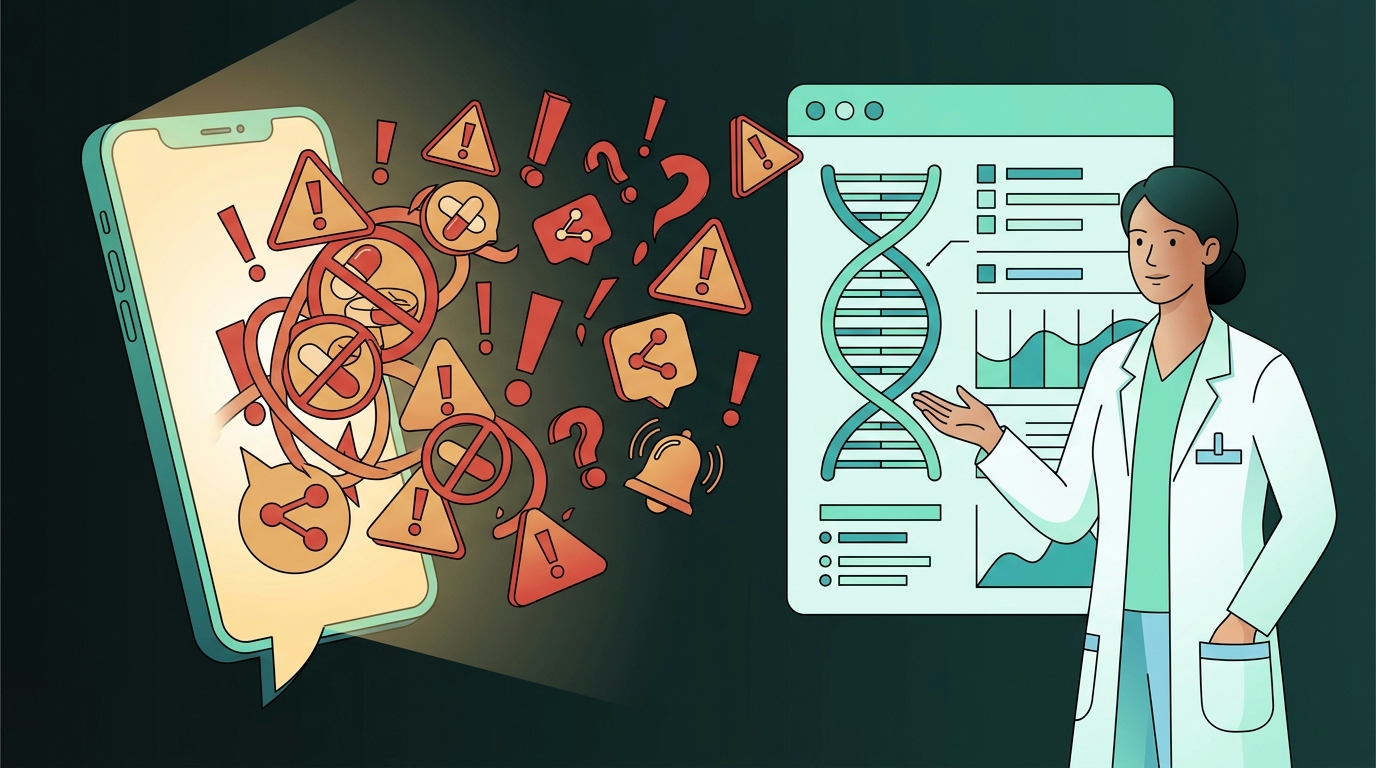
"You have cancer." Few sentences in medicine land harder. In the seconds after hearing them, most people's minds don't go to biology — they go to every frightening story they've ever heard: a neighbour who "wasted away," a forwarded WhatsApp message about a fruit that "cures" tumours, a video insisting doctors are hiding the truth. Fear makes us reach for information fast, and the internet is very good at supplying it — just not always the correct kind.
Over years of oncology practice, I've noticed the same handful of myths surface again and again, from patients, from families, from people who don't have cancer but are terrified of it anyway. Some of these myths cause panic. Others cause the opposite — a false sense of safety, or a search for shortcuts that delays real treatment. Both are dangerous. Let's go through the most common ones, one at a time, and replace fear with facts.
Myth 1: "Cancer is always a death sentence"
A cancer diagnosis means your life is effectively over — it's just a matter of time.
"Cancer" is not one disease with one outcome — it's hundreds of different diseases, each with its own behaviour, stage, and treatment options. Many cancers caught early are cured outright. Many others, even at an advanced stage, are now managed for years as a chronic, controllable condition — similar in principle to how we manage diabetes or high blood pressure. Survival rates for numerous cancer types have improved dramatically over the past two to three decades because of earlier detection and better treatments. A diagnosis is a starting point for a treatment plan, not an automatic verdict.
Myth 2: "Sugar makes cancer grow faster"
Cancer cells "feed" on sugar, so cutting sugar out of your diet completely will starve the tumour.
It's true that cancer cells, like every cell in your body, use glucose for energy — that's actually the biological principle behind the PET scan used to detect tumours. But eating sugar does not selectively "feed" a tumour any more than it feeds your heart or your brain, both of which also run on glucose. There is no reliable evidence that avoiding dietary sugar shrinks tumours or improves outcomes. What extreme sugar-elimination diets can do is cause dangerous, unintended weight loss at exactly the time your body needs strength to tolerate treatment. The evidence-based approach is a balanced diet, ideally guided by your oncology team or a clinical dietitian — not an all-or-nothing food rule based on a half-understood mechanism.
Confused by something you read online about your own diagnosis? A consultation gives you a direct, evidence-based answer instead of another forwarded message.
Book a consultationMyth 3: "Cancer is strictly hereditary — if it's not in my family, I'm safe"
Cancer only happens if it "runs in the family." No history means no risk.
Only about 5–10% of cancers are linked to a specific inherited genetic mutation, such as BRCA1/BRCA2 in some breast and ovarian cancers. The overwhelming majority arise from a combination of factors that have nothing to do with family history: ageing (the single biggest risk factor for most cancers), lifestyle exposures like tobacco and alcohol, environmental factors, infections, and simply the accumulation of random genetic errors in cells over a lifetime. Having no family history does not mean no risk — it means your risk profile is shaped by different factors, which is exactly why age-appropriate screening (mammograms, colonoscopies, Pap smears, and others) matters for everyone, not just people with a family history.
Myth 4: "Modern medicine has a secret cure, but it's hidden for profit"
Pharmaceutical companies and doctors already have a cure for cancer — they're withholding it because ongoing treatment is more profitable than a cure.
This idea doesn't survive contact with how cancer research actually works: it happens across thousands of competing universities, hospitals, biotech companies, and government agencies in dozens of countries, publishing results openly and racing to be first — a single hidden universal cure simply couldn't stay secret in a system built on competition and publication. What has actually happened is less dramatic but very real: steady, hard-won progress. Targeted drugs that attack the specific mutations driving a person's cancer, immunotherapy that helps the body's own immune system fight tumours, and earlier detection through better screening have measurably improved survival for many cancer types over the past two decades. It isn't one secret breakthrough — it's an accumulation of thousands of smaller ones, still ongoing.
Myth 5: "If a treatment has side effects, it must be doing more harm than good"
Chemotherapy and radiation are so toxic that they cause more damage than the cancer itself — "natural" alternatives are safer.
Cancer treatments do carry real side effects, and no honest oncologist will tell you otherwise — but every standard treatment is prescribed because, in careful clinical trials involving thousands of patients, its benefit was shown to outweigh its risk for that specific cancer and stage. Side effects today are also far more manageable than they were a generation ago, thanks to better supportive medications for nausea, pain, and immune protection. Delaying or replacing proven treatment with unproven "natural" alternatives — while understandable given fear of side effects — has been associated with substantially worse outcomes in the research that has studied it.
Why these myths matter more than they seem
None of these beliefs are harmless curiosities. Believing cancer is an automatic death sentence can push someone into despair so deep they refuse a treatment plan that could have helped them — or avoid seeing a doctor at all, out of a sense that "there's no point." Believing a strict diet can substitute for treatment can lead someone to delay chemotherapy or surgery while trying an unproven regimen, giving the cancer time it didn't need to have. Believing family history is the only risk factor can lead people to skip screening they genuinely need. And believing that a hidden cure exists breeds a corrosive distrust of the very treatments most likely to help — sometimes pushing people toward expensive, unregulated "alternative" clinics instead.
The common thread is this: myths don't just create unnecessary fear — they change decisions. And in oncology, decisions made early, on accurate information, are often the ones that matter most.
The hopeful truth
Cancer treatment today looks almost nothing like it did even fifteen years ago. We have targeted therapies built for specific genetic mutations, immunotherapies that retrain the immune system, far more precise radiation and surgical techniques, and screening tools that catch disease earlier than ever before. Many cancers that were once considered universally fatal now have long-term survivors measured in years and decades, not months.
None of that progress is served by fear-driven misinformation. If you or someone you love has been diagnosed, the single most useful thing you can do is find a qualified oncologist you trust and ask them directly — about your specific diagnosis, your specific options, and the specific evidence behind them. Not a forwarded message. Not a stranger's testimonial. A conversation with someone trained to give you an honest, individualised answer.
Is cancer always fatal?
No. Outcomes vary enormously by cancer type, stage at diagnosis, and how it's treated. Many cancers — including some found at an advanced stage — are now managed as long-term chronic conditions, and many others are cured outright, especially when caught early.
Should I stop eating sugar completely if I have cancer?
No. There is no credible evidence that ordinary dietary sugar makes cancer grow faster or that cutting it out slows a tumour. Extreme sugar-elimination diets can cause harmful weight loss during treatment. A balanced diet, discussed with your care team or a clinical dietitian, is the evidence-based approach.
If no one in my family has had cancer, am I safe?
No. Only about 5–10% of cancers are linked to an inherited genetic mutation. The large majority arise from a combination of ageing, lifestyle, environmental exposures, and chance mutations that accumulate over a lifetime, regardless of family history.
Is there a secret cure for cancer being hidden from the public?
No. Cancer research is conducted and published openly across thousands of competing institutions and countries worldwide, making a hidden universal cure logistically implausible. What has genuinely happened is steady, unglamorous progress — better screening, targeted drugs, and immunotherapy — that has measurably improved survival for many cancers over the past few decades.
Why do these cancer myths matter if they seem harmless?
Believing them can cause real harm: despair that delays or stops treatment, unnecessary anxiety that damages quality of life, false confidence that skips screening, or pursuit of unproven remedies instead of, or alongside, treatments known to work.
Medical disclaimer: this article is educational information, not personal medical advice, and does not replace the care of your treating physician. If you have urgent symptoms, contact your local emergency services or hospital.