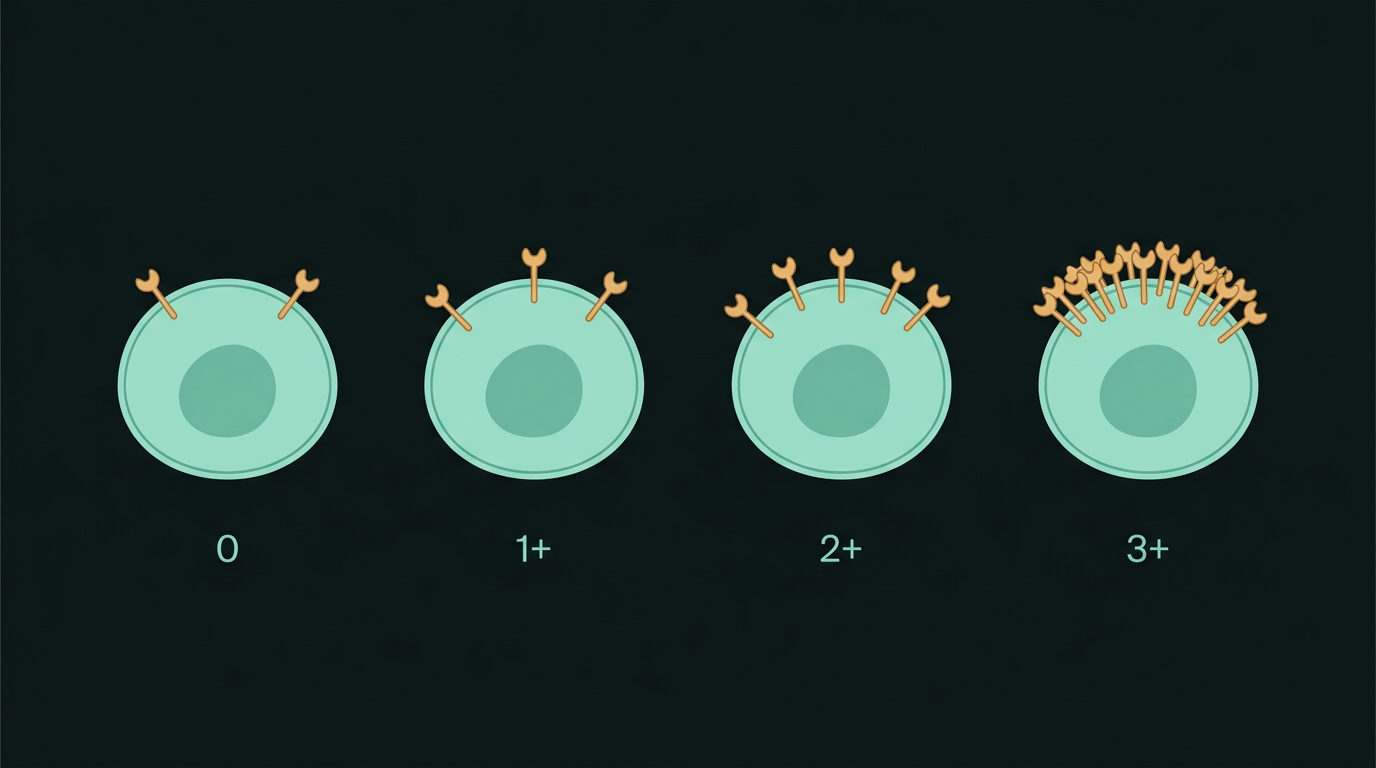
If your pathology report mentions "HER2" followed by a number and a plus sign — 0, 1+, 2+, or 3+ — that single line is one of the most important pieces of information in your entire report. It doesn't just describe your tumour; it points directly to which drugs are likely to work for you. Here's what each score actually means, and why it matters.
What HER2 is, in plain terms
HER2 (human epidermal growth factor receptor 2) is a protein that sits on the surface of breast cells and helps control how they grow and divide. In roughly 1 in 5 breast cancers, the gene that makes this protein is copied too many times, so the cell produces far more HER2 receptors than normal. Those extra receptors act like a stuck accelerator pedal — sending constant "grow and divide" signals that drive the cancer.
The reason this matters so much is that HER2 isn't just a marker of aggressive behaviour — it's a target. Drugs like trastuzumab and several others are built specifically to attach to HER2 and block that signal, and they have transformed outcomes for HER2-positive breast cancer over the past two decades.
How HER2 is scored: 0, 1+, 2+, 3+
HER2 is usually tested in two stages on your biopsy or surgical sample.
Step 1 — Immunohistochemistry (IHC)
A stain highlights how much HER2 protein is on the cell surface, scored on a 0–3+ scale:
- HER2 0 — no staining, or very faint/incomplete staining in a small fraction of cells. Considered HER2-negative.
- HER2 1+ — faint, incomplete staining in more than 10% of cells. Also HER2-negative for targeted-therapy purposes, but now classed as "HER2-low" (see below).
- HER2 2+ — moderate, complete staining. This result is equivocal — it can't be called positive or negative from the stain alone.
- HER2 3+ — strong, complete staining in more than 10% of cells. This is HER2-positive.
Step 2 — FISH (only needed for 2+ / equivocal results)
If your IHC comes back 2+, the lab performs a second test — fluorescence in-situ hybridization (FISH) — which counts the actual number of HER2 gene copies in the cell rather than just the protein on its surface. FISH gives a clear positive or negative answer where IHC alone could not, and it's this combined result that determines treatment eligibility.
Trying to make sense of your own pathology report? A report-review consultation walks through every line — HER2, ER/PR, grade, staging — in language built for your situation.
Book a consultationWhat each result means for treatment
HER2-positive (3+, or 2+/FISH-amplified) qualifies for HER2-targeted therapy — typically combined with chemotherapy, and often continued afterward as maintenance treatment. These drugs specifically block the HER2 signal driving the cancer, and for many patients they meaningfully improve both response to treatment and long-term outcomes compared with chemotherapy alone.
HER2-negative (0) means HER2-targeted drugs won't help, and treatment is guided instead by other markers — most importantly hormone receptor status (ER/PR) and, where relevant, genomic tests that help decide whether chemotherapy adds benefit.
HER2-low (1+, or 2+/FISH-negative) is a newer, clinically important category. These tumours don't qualify for the original HER2-targeted drugs, but they do respond to a newer class of "antibody-drug conjugates" designed specifically for HER2-low disease — a treatment option that didn't exist a few years ago.
Why this is worth understanding, not just reading past
Two patients with what looks like "the same" breast cancer on imaging can have completely different treatment plans once HER2 status is known. Understanding where your own result sits on this scale — and asking your oncologist directly whether your report says 0, 1+, 2+ (and if so, what the FISH result was), or 3+ — is one of the clearest ways to understand why your specific treatment plan looks the way it does.
Is HER2 2+ positive or negative?
HER2 2+ is "equivocal" — neither clearly positive nor negative on the initial stain. It requires a follow-up test, usually FISH, to check the actual number of HER2 gene copies before treatment can be decided.
Can HER2 status change over time?
Yes. HER2 status can differ between the original biopsy and a later sample (for example, after chemotherapy or at recurrence), which is one reason your oncologist may recommend re-testing a new biopsy if your cancer changes or returns.
Does HER2-positive mean a worse prognosis?
Historically HER2-positive cancers behaved more aggressively, but the introduction of HER2-targeted drugs has changed this substantially — many HER2-positive cancers now respond very well to treatment, often better than some HER2-negative subtypes.
What is HER2-low, and is it new?
HER2-low describes tumours scored 1+ or 2+ (FISH-negative) — previously grouped with HER2-negative, but now recognised as its own category eligible for a newer class of HER2-targeted antibody-drug conjugates.
Medical disclaimer: this article is educational information, not personal medical advice, and does not replace the care of your treating physician. If you have urgent symptoms, contact your local emergency services or hospital.